



La versione inglese di “Waiting for Godot“
Antico e moderno: chi avrebbe mai detto che due categorie apparentemente opposte potessero coesistere nello stesso spazio artistico?
Da un lato c’è il classico, incarnato dall’imponente scenografia del Teatro Romano di Volterra, cornice del Festival Internazionale Teatro Romano Volterra – luogo d’eccezione che incanta per la sua bellezza e che ha ottenuto l’Alto Patrocinio dell’UNESCO e della Presidenza della Repubblica, oltre al sostegno dell’Ambasciata di Francia. Dall’altro c’è il contemporaneo, che calca la scena con Waiting for Godot (Aspettando Godot) di Samuel Beckett, pièce intrisa della semantica tipica del Teatro dell’Assurdo, maturatosi all’ombra della filosofia esistenzialista nel secondo dopoguerra.
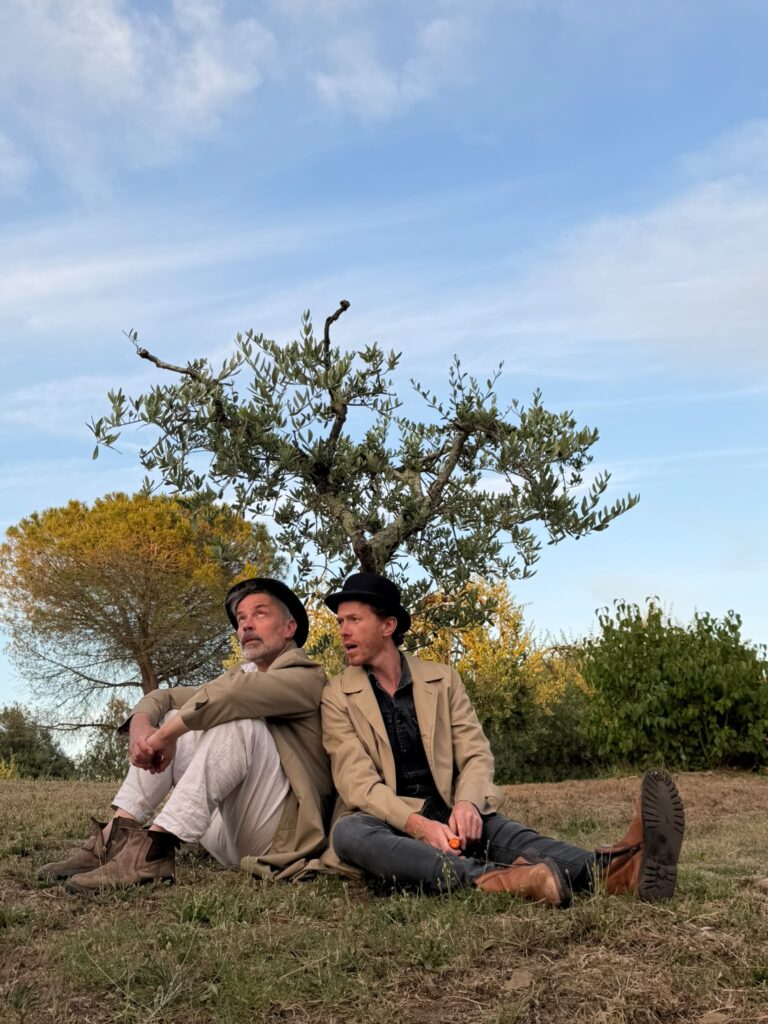
Justin Butcher (Vladimir-Didi), Nicholas Scott Redding (Estragon-Gogo)
La versione andata in scena è firmata dalla J. Productions di Milano, che ha regalato al pubblico due serate magiche proponendo una rara e preziosa edizione del dramma interamente in lingua inglese.
Il testo beckettiano ha rappresentato un fondamentale spartiacque nel Novecento, incidendo profondamente sulla drammaturgia contemporanea. Rappresentato per la prima volta nel 1953, lo spettacolo si fa portabandiera del Teatro dell’Assurdo, rompendo in modo radicale con la tradizione del dramma borghese e con la struttura aristotelica classica.
A differenza di filosofi esistenzialisti come Sartre e Camus, i quali ritenevano che l’uomo potesse in qualche modo costruire un senso per la propria esistenza, Beckett con il Teatro dell’Assurdo recide ogni speranza: mostra un mondo vuoto in cui qualsiasi ricerca di significato risulta vana. L’opera di Beckett propone infatti il nulla come sostanza stessa dell’azione, spingendoalle estreme conseguenze i presupposti dell’ideologia esistenzialista: l’agire dei personaggi non produce alcun progresso, ma diventa pura forma per riempire il vuoto dell’essere. Sulle orme beckettiane si incammineranno poi autori come Ionesco e Genet, fino alla seconda generazione di drammaturghi rappresentata da Pinter e Boris Vian.
Lo spettacolo andato in scena ha incarnato perfettamente lo spirito dell’autore irlandese. Sebbene il testo sia stato scritto in francese tra il 1948 e il 1949 e tradotto dall’autore in inglese nel 1954, la resa linguistica in inglese è apparsa ideale per veicolare i concetti messi in scena, mantenendo qualche fraseggio in francese – come a ricordare la scelta originale di Beckett– orientata a una lingua romanza essenziale e priva di orpelli retorici, capace di esaltare il tono ironico e spiazzante dell’opera (gli stessi nomi Didi e Gogo mantengono una chiara matrice affettiva e linguistica francese). Il linguaggio è ciclico, ripetitivo, dissacrante ed esilarante: tutto è la contraddizione di tutto, persino di se stessi. Non esistono certezze poiché esige il dubbio di ogni forma di pensiero e linguaggio.
Vladimir-Didi è la mente e lo spirito: non a caso è colui che all’inizio della scena scruta il suo cappello in cerca di un senso all’attesa stessa. È la parte intellettuale della coppia che ha una particolare ossessione per la memoria e pone dilemmi religiosi e metafisici, come la parabola dei due ladroni crocifissi con Cristo. Essendo la parte razionale, cerca di mantenere una certa dignità e un pizzico di speranza. Estragon-Gogo è letteralmente la parte che ragiona “con la pancia” e ha istinti più semplici, primordiali e animali come la fame e il bisogno di dormire; inoltre, in contrapposizione con Didi, ha sempre dolore ai piedi per via degli stivali stretti, segnale metaforico del contatto con la terra e con tutto l’esistere materiale. I due hanno un legame indissolubile: è come se fossero connessi come due calamite che provano, in forma minacciosa, a distaccarsi, ma non possono farlo poiché l’uno per l’altro sono la prova esatta della propria esistenza nel vuoto cosmico. Nel loro lungo interloquire sopraggiunge Pozzo, l’incarnazione del Potere Materiale e della figura del Padrone. È un personaggio spietato e crudele, dotato di frusta, che mostra il suo dominio capitalistico ed egoistico sfogando tutta la sua tirannia nei confronti di Lucky, il suo servo, legato con una corda al collo. Lucky è un personaggio passivo che si trova costretto a subire le cattiverie, a portare pesi e ad eseguire gli ordini imposti dal suo padrone, per poi sfociare, nel primo atto e sull’ennesima richiesta di Pozzo di parlare, in un monologo infinito senza freni, dove saranno i due personaggi di Didi e Gogo a cercare di far smettere in maniera goffa il suo delirante discorso. Nel secondo atto, Lucky non ha più l’arte della parola e nemmeno gli altri suoi sensi sono del tutto attivi, mostrando una grande incapacità di difendersi. È la tragedia della cultura e dell’intelletto messi a disposizione del potere, resa fragile e indebolita proprio da quella spietata tirannia, dove quest’ultima, al contrario, si eleva e prende il sopravvento. E Godot? Già, quell’uomo che non vediamo mai e che rimanda il suo arrivo non è nient’altro che un’entità divina o la salvezza trascendentale che promette la religione, ma che alla fine risulta assente alla preghiera disperata dell’uomo. Godot è la chiave di tutto il malessere, è il futuro e l’illusione su cui l’uomo scommette per purificarsi e uscire dalla sua attuale misera esistenza. Godot è la pace e la quiete dopo ogni tempesta bellica che le società auspicano e bramano per la fine di ogni guerra che persevera, in risposta al massacrante secondo conflitto mondiale da cui stava faticosamente uscendo il mondo dopo il 1945. Sarà un ragazzo, un messaggero dalle sembianze angeliche, a fare da tramite tra i due protagonisti e Godot, comunicando sempre il rinvio a domani dell’arrivo dell’entità sconosciuta ma tanto attesa da tutti. L’ambasciatore dei messaggi di Godot accentua la dimensione eterea del personaggio, trasformato in un’apparizione sospesa tra cielo e terra.
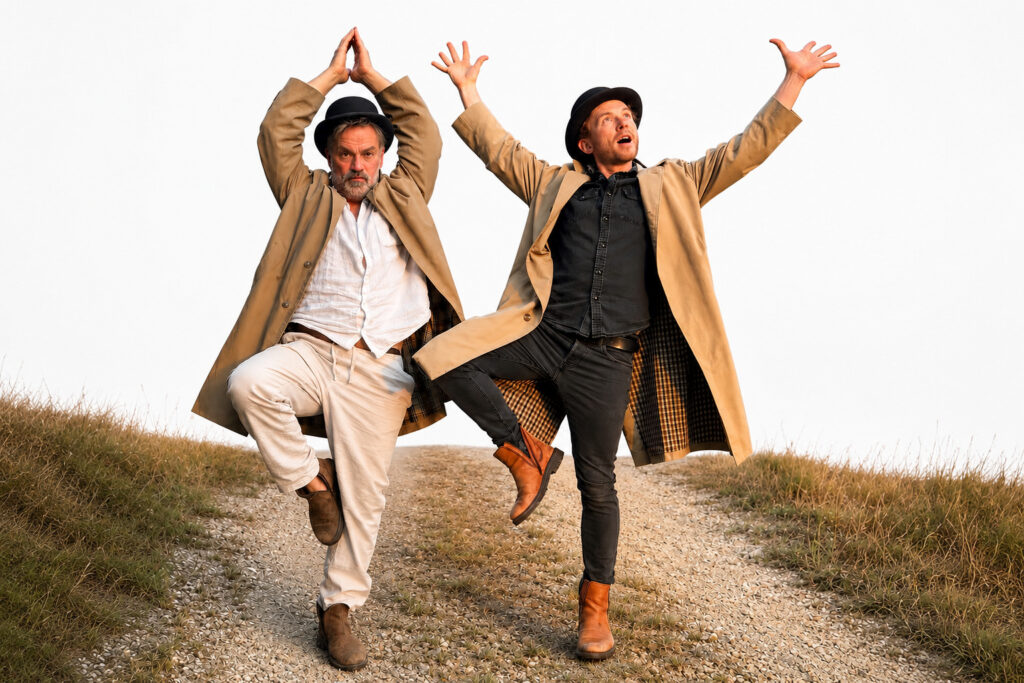
Gli attori, soprattutto l’interprete di Gogo, presentano dei virtuosismi acrobatici tipici della clownerie che l’opera senz’altro richiede. Si muovono nello spazio circostante con una consapevolezza corporea notevole e un’elasticità tale da non farsi male sul palco nei movimenti più drastici. Lo slapstick, ovvero l’elemento comico-clownesco del genere dettato da azioni esagerate come cadute, colpi e inseguimenti, non è mancato nello spettacolo, così come non sono mancate le scene iconiche dello scambio dei cappelli e della caduta dei pantaloni, che esasperano il carico simbolico della scena senza mai smorzare la tensione né vanificare il senso del dramma. In contrasto con i movimenti scenici, risalta l’immobilismo della loro paralisi, che costringe i personaggi a non lasciare quel luogo desolante, a richiamare quella gabbia della volontà e dell’anima.
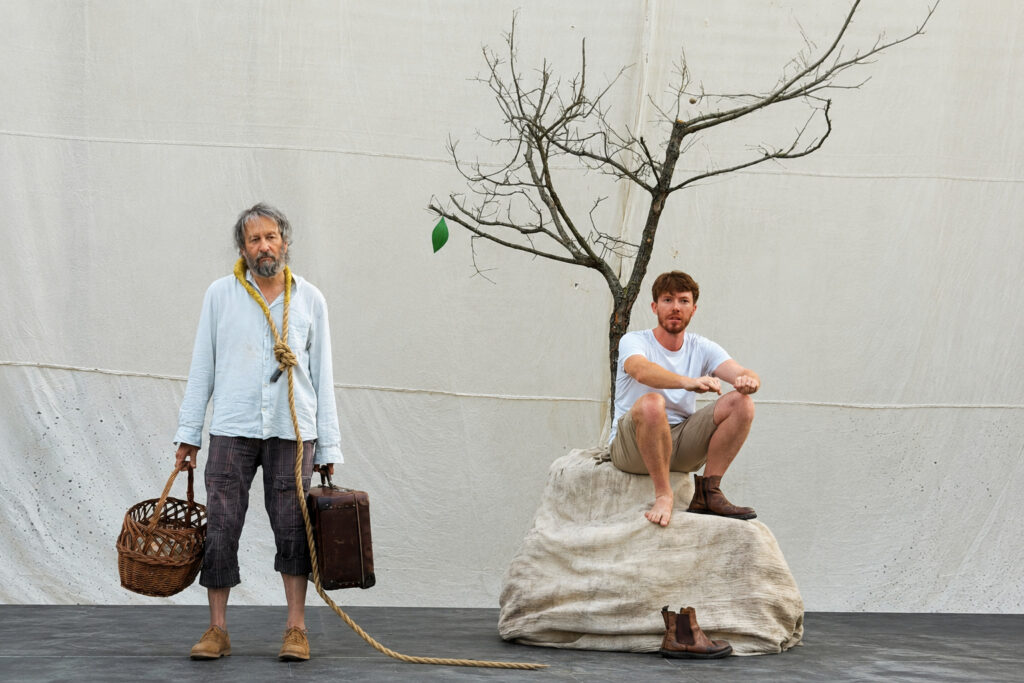
Gli elementi scenici accompagnano tutta la rappresentazione con un carico allegorico altrettanto rilevante: l’albero, dapprima spoglio al centro della scena e poi ornato da poche foglie, fa da pilastro alla struttura simbolica poiché incarna il Calvario cristiano della condizione umana in attesa della propria salvezza e la tentazione del suicidio come unica soluzione possibile (che però fallisce sempre). La metamorfosi naturale dell’albero è l’atto stesso della primavera, che rappresenta in sé il senso del cambiamento e la speranza ingannevole che impedisce a Didi e Gogo di arrendersi e li spinge a mettersi ancora in attesa dell’arrivo di Godot. La luce blu e la raffigurazione della Luna presagiscono la notte e la constatazione che Godot arriverà forse l’indomani, trasformando la recitazione dei due personaggi in un elemento visivo che risalta la plasticità dei corpi. La polvere che risiede negli abiti dei personaggi rappresenta lo scorrere del tempo che passa inesorabilmente anche in assenza di eventi. È la raffigurazione della perdita di un ruolo sociale oltre che il richiamo biblico alla cenere, “Polvere sei e polvere ritornerai”, in cui si anticipa il passaggio di decomposizione della materia ancora prima della fine ciclica dell’esistenza dell’uomo sulla terra.
Anche gli abiti risaltano un riferimento cromatico metaforico: la palette di colori spenti come il marrone, il color fango, l’ocra, il grigio e il nero scolorito delle bombette e delle giacche richiamano il lutto esistenziale, la mancanza di luce e l’azzeramento della vitalità.
Il simbolismo di Beckett si ritrova nella bellezza delle rovine antiche del Teatro Romano di Volterra, simbolo di quella decadenza che è sopravvissuta al tempo e alle sovrastrutture architettoniche delle civiltà succedutesi all’età etrusco-romana.
La scelta registica di Rupert Mason e della produzione di Julia Holden è una mossa audace che scruta nel profondo della desolante condizione umana, soprattutto di quella attualmente in corso -dettata da due guerre e reduce da una pandemia mondiale che ha scalfito la società moderna- e l’adattamento in lingua inglese è una scelta che identifica il linguaggio mondiale della condizione geo-politica dei conflitti di oggi.
Volterra è uno scenario perfetto per adattamenti culturali come questi: terra di scoperte archeologiche importanti come quelle di Enrico Fiumi (a cui quest’anno è dedicato il Festival a cinquant’anni dalla sua scomparsa), che ha rilanciato la città in tutto il suo splendore nell’arte romana e di cui ancora oggi si possono ammirare le bellezze etrusco-romane; ma anche terra che ha conosciuto il Medioevo nella trasformazione di una città sempre in movimento, fortemente apprezzata come ambientazione per il film Twilight nella corsa affannosa di Bella Swan (Kristen Stewart) per salvare il suo Edward (Robert Pattinson) dalle grinfie dei Volturi, potente clan di vampiri residente proprio a Volterra. Una terra che ha conosciuto il senso del dolore con la presenza del Manicomio di Volterra, l’ex ospedale psichiatrico nato nel 1887 e chiuso nel 1978 con la Legge Basaglia (che decretò la chiusura dei manicomi) e che corrisponde tuttora al Borgo San Lazzero. Da non dimenticare, l’illustre ed ammirevole battaglia condotta dalla Compagnia della Fortezza, che svolge attività e spettacoli teatrali nel penitenziario locale. Insomma, non poteva che essere Volterra la città ideale per promulgare il pensiero e la filosofia di Beckett, in una drammaturgia che è ancora in attesa di un Godot che non arriva mai.
____________________
Waiting for Godot di Samuel Beckett – uno spettacolo della J. Production (Regno Unito) – Regia di Rupert Mason – Con Justin Butcher (Vladimir-Didi), Nicholas Scott Redding (Estragon-Gogo), Tony Bell (Pozzo), Jon Kellam (Lucky), Madeline Wolf (Boy) – Produttrice Julia Holden – Prodotto dalla J. Productions, Milan, in associazione con il Festival Internazionale Teatro Romano Volterra – dal 29 al 30 luglio al Teatro Romano di Volterra – Foto © Ufficio Stampa
Beckett’s decadentism marries the Roman Theatre of Volterra
The English version of “Waiting for Godot“
Ancient and modern: who would have thought that two seemingly opposing categories could coexist in the same artistic space?
On the one hand, there is the classical, embodied by the imposing scenography of the Roman Theatre of Volterra, the setting for the Volterra International Festival Teatro Romano – an exceptional place that enchants with its beauty and which has obtained the UNESCO High Patronage and the Presidency of the Republic, as well as the support of the French Embassy. On the other one, is the contemporary, who takes center stage with Samuel Beckett‘s Waiting for Godot, a play steeped in the semantics typical of the Theatre of the Absurd, which matured in the shadow of existentialist philosophy in the post-war period.
The staged version is by J. Productions of Milan, which gave to the audience two magical performances by offering a rare and precious edition of the drama entirely in English.
Beckett‘s text represented a fundamental watershed in the Twentieth Century, profoundly impacting contemporary dramaturgy. Performed firstly in 1953, the play became the standard-bearer of the Theatre of the Absurd, radically breaking with the tradition of bourgeois drama and the classical Aristotelian structure.
Unlike existentialist philosophers such as Sartre and Camus, who believed that man could somehow construct meaning for his own existence, Beckett with the Theatre of the Absurd severs all hope: he shows an empty world in which any search for meaning is futile. Indeed, Beckett‘s work proposes nothingness as the very substance of action, pushing the presuppositions of existentialist ideology to their extreme consequences: the actions of the characters do not produce any progress, but become pure form to fill the void of being. Authors such as Ionesco and Genet would then follow in Beckett‘s footsteps, up to the second generation of playwrights represented by Pinter and Boris Vian.
The performance which went on stage perfectly embodied the spirit of the Irish author. Although the text was written in French between 1948 and 1949 and translated by the author into English in 1954, the linguistic rendering in English seemed ideal for conveying the concepts staged, maintaining some phrasing in French – as if to recall Beckett‘s original choice – oriented towards an essential Romance language and devoid of rhetorical frills, capable of enhancing the ironic and disconcerting tone of the work (the names Didi and Gogo themselves maintain a clear French affective and linguistic matrix). Language is cyclical, repetitive, irreverent, and exhilarating: everything is the contradiction, even of oneself. There are no certainties since it demands the doubt of every form of thought and language.
Vladimir-Didi is the mind and the spirit: it is no coincidence that he is the one who, at the beginning of the scene, scrutinizes his hat looking for the meaning for the wait itself. It is the intellectual part of the couple that has a particular obsession with memory and poses religious and metaphysical dilemmas, such as the parable of the two thieves crucified with Christ. Being the rational part, he tries to maintain a certain dignity and a pinch of hope. Estragon-Gogo is literally the reasoning part “with his belly” and he has simpler, more primal, and animalistic instincts such as hunger and the need to sleep; furthermore, unlike Didi, he always has pain in his feet due to his tight boots, a metaphorical sign of contact with the earth and all material existence. Both have an indissoluble bond: it is as if they were connected like two magnets that try, in a threatening form, to detach themselves, but cannot do so since for each other they are exact proof of their existence in the cosmic vacuum. During their long conversation comes Pozzo, the embodiment of Material Power and the figure of the Master. He is a ruthless and cruel character, equipped with a whip, who shows his capitalist and selfish domination by venting all his tyranny towards Lucky, his servant, tied with a rope around his neck. Lucky is a passive character who finds himself forced to endure the wickedness, to carry burdens and to carry out the orders imposed by his master, and then, in the first act and at Pozzo’s umpteenth request to speak, he ends up in an endless, unrestrained monologue, where the two characters of Didi and Gogo will try to awkwardly stop his delirious speech. In the second act, Lucky no longer has the art of speech and his other senses are not entirely active either, showing a great inability to defend himself. It is the tragedy of culture and intellect placed at the disposal of power, rendered fragile and weakened precisely by that ruthless tyranny, where the latter, on the contrary, rises and takes over. And what about Godot? Yes, that man who we never see and who postpones his arrival is nothing more than a divine entity or the transcendental salvation that religion promises, but which ultimately proves absent from man’s desperate prayer. Godot is the key to all malaise, it is the future and the illusion that man bets on to purify himself and emerge from his current miserable existence. Godot is the peace and quiet after every storm of war that societies hope for and long for an end to every war that persists, in response to the grueling Second World War from which the world was laboriously emerging after 1945. It will be a boy, a messenger with angelic features, who will act as intermediary between the two protagonists and Godot, always communicating the postponement until tomorrow of the arrival of the unknown entity but long-awaited by everyone. The ambassador for Godot’s messages accentuates the ethereal dimension of the character, transformed into an apparition suspended between heaven and earth.
The actors, especially Gogo’s interpreter, present acrobatic virtuosity typical of clowning that the work certainly requires. They move through the surrounding space with remarkable body awareness and elasticity that doesn’t hurt themselves on stage in the most drastic movements. Slapstick, the comic-clown element of the genre dictated by exaggerated actions such as falls, blows, and chases, was not lacking in the show, just as the iconic scenes of the exchange of hats and the fall of trousers were not lacking, which exaggerate the symbolic load of the scene without ever dampening the tension or undermining the meaning of the drama. In contrast to the scenic movements, the immobility of their paralysis stands out, which forces the characters not to leave that desolate place, to recall that cage of will and soul.
The scenic elements accompany the entire performance with an equally significant allegorical load: the tree, initially bare in the center of the scene and then adorned with a few leaves, acts as a pillar of the symbolic structure since it embodies the Christian Calvary of the human condition awaiting its own salvation and the temptation to commit suicide as the only possible solution (which, however, always fails). The natural metamorphosis of the tree is the very act of spring, which represents in itself the sense of change and the deceptive hope that prevents Didi and Gogo from giving up and pushes them to still wait for Godot’s arrival.
The blue light and the depiction of the Moon foreshadow the night and the realization that Godot will perhaps arrive the next day, transforming the acting of the two characters into a visual element that highlights the plasticity of the bodies. The dust that resides in the characters’ clothes represents the passage of time that passes inexorably even in the absence of events. It is the depiction of the loss of a social role as well as the biblical call to ashes, “Dust you are and dust you will return”, in which the passage of decomposition of matter is anticipated even before the cyclical end of man’s existence on earth.
Even the clothes stand out as a metaphorical chromatic reference: the palette of dull colors such as brown, mud, ochre, gray, and faded black of the bowler hats and jackets recall existential mourning, the lack of light, and the disappearance of vitality.
Beckett‘s symbolism is found in the beauty of the ancient ruins of the Roman Theatre in Volterra, a symbol of the decadence that has survived the times and architectural superstructures of the civilizations that succeeded the Etruscan-Roman era.
Rupert Mason‘s directorial choice and Julia Holden‘s production is a bold move that peers deep into the bleak human condition, especially of the one currently underway – dictated by two wars and fresh from a worldwide pandemic which has affected modern society – and the adaptation in English language is a choice that identifies the world language of the geopolitical condition of today’s conflicts.
Volterra is a perfect setting for cultural adaptations like these: a land of important archaeological discoveries such as those of Enrico Fiumi (to whom this year the Festival is dedicated fifty years after his death), who relaunched the city in all its splendor in Roman art and whose Etruscan-Roman beauty can still be admired today; but also a land that experienced the Middle Ages in the transformation of a city always on the move, strongly appreciated as the setting for the film Twilight in the frantic race of Bella Swan (Kristen Stewart) to save her lover Edward (Robert Pattinson) from the clutches of the Volturi, a powerful vampire clan residing right in Volterra.
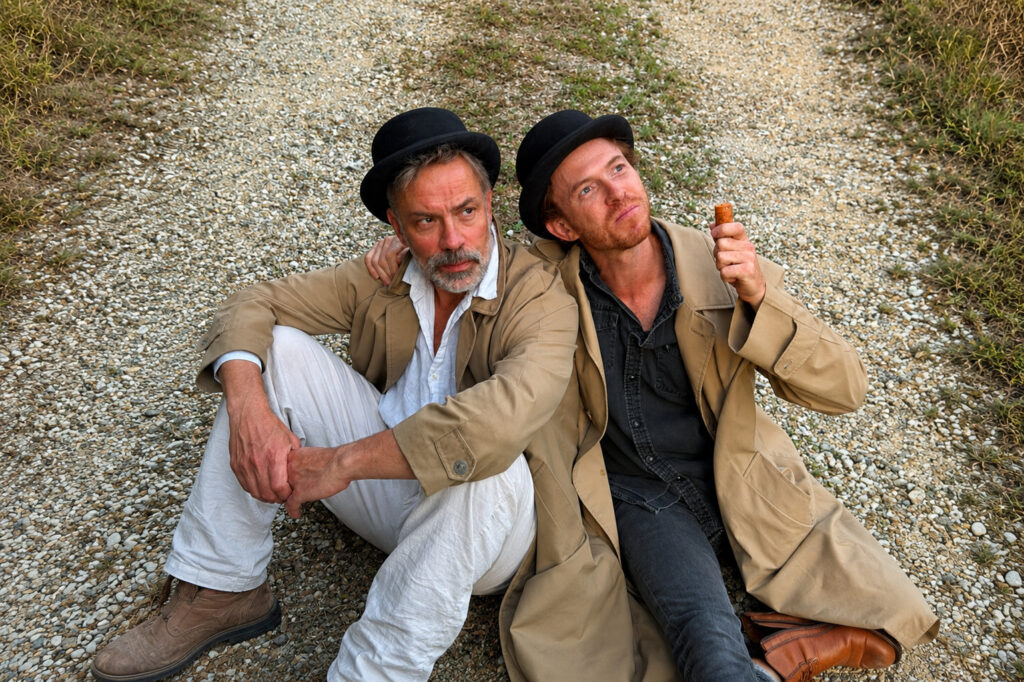
Justin Butcher (Vladimir-Didi), Nicholas Scott Redding (Estragon-Gogo)
A land that experienced a sense of pain with the presence of the Manicomio di Volterra, the former psychiatric hospital founded in 1887 and closed in 1978 with the Basaglia’s Law (which decreed the closure of asylums) and which still corresponds to Borgo San Lazzero. Not to be forgotten is the illustrious and admirable battle waged by the Compagnia della Fortezza, which carries out theatrical activities and performances in the local penitentiary. Therefore, Volterra could only be the ideal city to promulgate Beckett‘s thought and philosophy, in a dramaturgy that is still waiting for a Godot who never arrives.
____________________
“Waiting for Godot” by Samuel Beckett – a performance by J. Production (UK) – Director: Rupert Mason – Cast: Justin Butcher (Vladimir-Didi), Nicholas Scott Redding (Estragon-Gogo), Tony Bell (Pozzo), Jon Kellam (Lucky), Madeline Wolf (Boy) – Producer: Julia Holden – Produced by J. Productions, Milan, in association with Volterra International Festival Teatro Romano – from July 29th to 30th at the Roman Theatre of Volterra
Photos © Press Officer